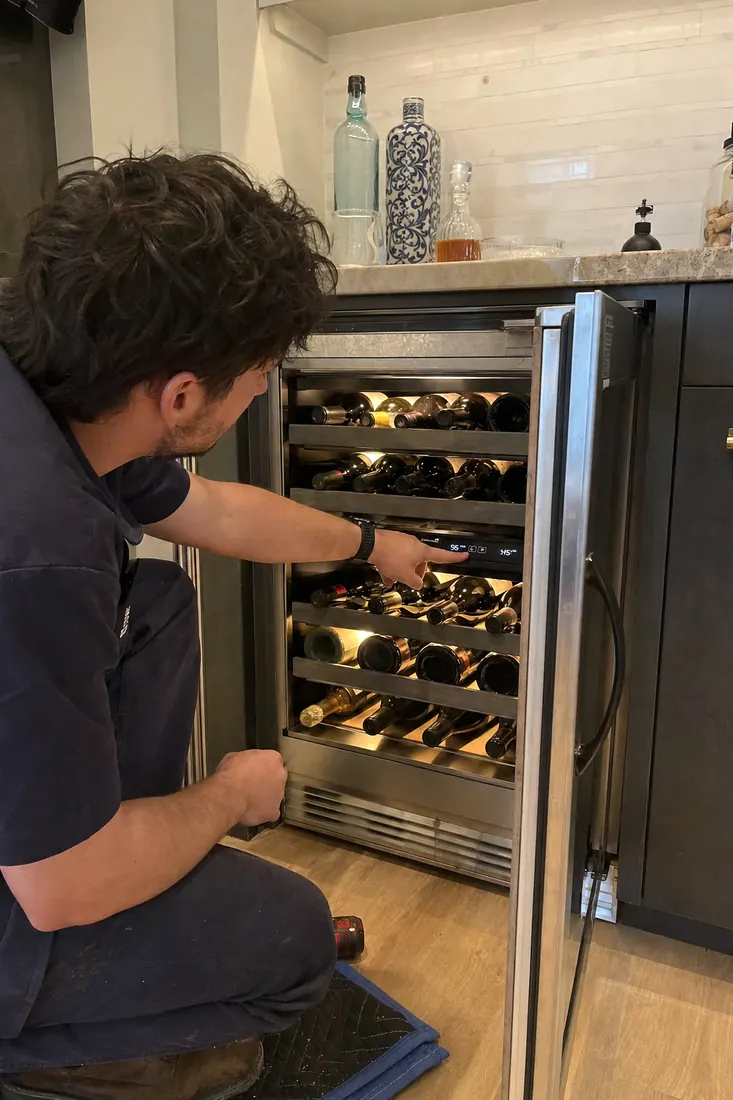
Most repair visits are decided before anyone arrives. The parts on the van, the tools, the time allocated and whether the job finishes in one visit all follow from what gets described on the phone. This guide is the short list of things worth establishing first — none of which requires taking anything apart.
Have the model and serial number
They are on a data plate, not on the front of the appliance. On built-in refrigeration it is usually inside the fresh-food compartment on the upper left side wall, or behind the top grille. On a wall oven, look on the frame behind the door when it is open. On a dishwasher, on the edge of the door or on the inner tub rim. On a hood, inside the canopy with the filters removed.
The model number tells us the platform, the serial number tells us the production revision, and appliances of the same model built two years apart do not always take the same part. Photographing the plate is faster than reading it back.
Describe the pattern, not just the symptom
“It stopped working” and “it stops working after a storm and is fine by morning” lead to two different visits. The second tells us to test the supply as well as the appliance, which on the First Coast — with roughly 68 thunderstorm days a year — is a common and frequently correct suspicion.
Useful pattern information:
- When it started, and whether anything changed in the house at the same time
- Whether it is constant or intermittent, and whether the intermittency has a rhythm — time of day, weather, heavy use
- Whether it recovers on its own
- Whether more than one appliance started behaving oddly in the same week
Say where the appliance actually is
Not just the address — where in the kitchen, and what is around it.
Three details change what gets loaded before anyone leaves.
Is it built-in, integrated or freestanding? A freestanding machine rolls out. A built-in column comes forward on rails carrying several hundred pounds with the doors still on. An integrated dishwasher or refrigerator cannot move at all until its cabinet panel comes off, and where the millwork was fitted around the appliance after installation, a length of trim comes off before that.
Is it in an island, under a counter, or in a tall stack? Undercounter units and appliances stacked above or below an oven have services entering from behind and no working space in front. Getting to the back of one is frequently the longest part of the visit, and knowing in advance is what stops it becoming a second visit.
Is the property gated, and is there a lift or a stair? Access arranged at booking costs nothing. Access discovered on the day costs the appointment.
Two checks anyone can do safely
Refrigeration: does it still cycle off? Stand near the unit for a few minutes in mild weather. A built-in that runs more or less continuously, while still holding the right temperature, is usually telling you about its condenser airflow — a fouled coil, a failed condenser fan, or on the coastal ZIPs a corroded fin pack. Run time is the earliest honest symptom and it appears long before a temperature complaint.
On a dual-system unit — most built-in and column refrigeration — also note which side is wrong. A freezer holding temperature says nothing about the fresh-food system beside it; they are two machines sharing a cabinet, and knowing which one is involved removes half the possible causes before anyone arrives.
Ice makers: look at the mold. Pull the bin out. A white, chalky film on the mold fingers or a crust around the fill cup answers most of what a first visit would ask. Clear, full-size cubes with a clean mold point somewhere electrical instead.
What not to do
Do not run a maintenance cycle repeatedly hoping a fault clears. These machines count cycles rather than measure their own condition, so a prompt that returns immediately after being cleared is telling you the accessible path was cleared and whatever lies past it was not. Running it again does not reach further.
Do not adjust an oven’s calibration offset to correct a temperature complaint before the cavity has been measured. Trimming the offset to mask a drifting sensor hides the fault and makes the next visit harder.
Do not hose down a condenser coil on a coastal address. Wetting salt deposit and leaving it in place sustains the corrosion rather than removing it.
Ask about the part before you approve the work
Components for built-in and professional equipment are ordered against the serial number rather than the model alone, because the same model built two years apart does not always take the same part. That is why the serial number is worth photographing, and it is also why lead times vary so much between jobs that look similar.
As a rough guide: door hardware, gaskets, thermistors, fan motors and capacitors are ordinary stock. Sealed-system components, inverter boards and steam-generator assemblies are the ones that wait. Where the diagnosis lands on one of those, the expected wait goes on the written estimate before anything is ordered, so you are deciding with the timescale in front of you rather than finding out afterwards.
What happens on the visit
The diagnostic is a flat fee, credited toward the repair when you approve the work. It covers the visit and the diagnosis, including pulling and reseating a built-in unit where that is what it takes to reach the fault. You get a written estimate — parts and labor itemised — before any part is ordered. If a repair is not economic against the value of the unit, we say so at that point rather than after starting.
Two limits are worth knowing in advance. If the appliance is still inside a manufacturer warranty period, the manufacturer’s own network may be required to carry out covered work, and we will tell you that rather than take the job. And where a repair would cost a large fraction of what the appliance is worth — a corroded sealed system, a discontinued assembly, a cabinet that would have to be rebuilt around a replacement — that goes on the estimate as a number rather than as a recommendation.