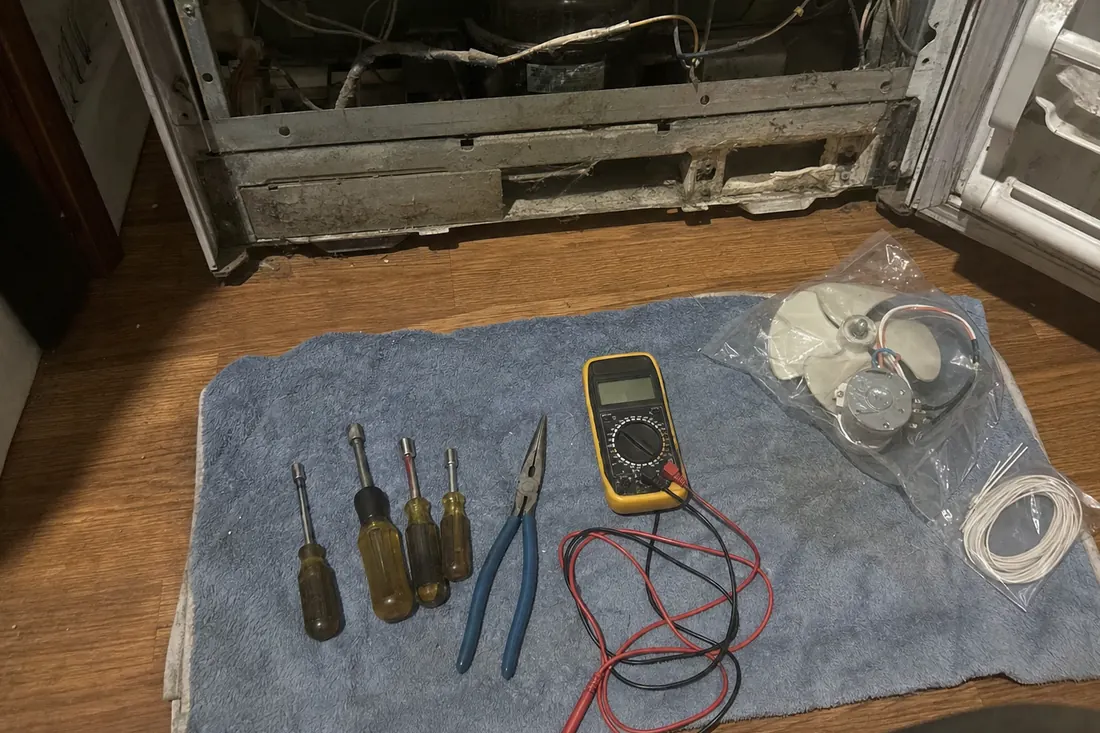
A refrigerator on Amelia Island and the same model in Mandarin are not doing the same job. The one on the island is rejecting heat into air that carries salt, and salt has a specific, predictable effect on the part of the machine designed to reject that heat.
Which ZIPs this applies to
The coastal band on the First Coast is narrow and it matters. Ponte Vedra Beach 32082, Jacksonville Beach 32250, Neptune Beach 32266, Atlantic Beach 32233 and the coastal side of St. Augustine 32084 are the ZIPs where airborne salt is the dominant corrosion driver, together with Amelia Island in Nassau County. Three miles inland the same appliance ages on a completely different schedule.
The order things fail in
Salt corrosion is not random. It works through the machine in a consistent sequence, and knowing the sequence tells you how far along a unit is.
Fasteners first. Screws, clips and the small hardware holding grilles and trim in place. They are usually a different alloy from the panel around them, and the galvanic couple accelerates the attack.
Hinge pins and dampers next. Anything that moves through a bearing surface in open air. On a range hood, the backdraft damper is the first moving part to seize, often part-open, which then lets humid outside air into the duct continuously.
Condenser fin stock third. This is the one that costs money. A condenser is thin aluminium fin bonded to tube, with an enormous surface area relative to its mass — exactly the geometry that corrodes fastest. As the fins degrade and lose contact with the tube, the coil’s ability to move heat into the air drops.
Visible stainless last. By the time the trim is streaking, the fin pack has usually been degrading for years.
Why the symptom is run time, not temperature
This is the part owners consistently miss, and it is the single most useful idea in this guide.
A refrigerator with a compromised condenser does not immediately run warm. Its control does exactly what it was designed to do: it holds the setpoint by running the compressor longer. The cabinet temperature stays correct. The electricity bill and the wear rate go up. Nothing on the display suggests a problem.
The unit only starts running warm when the compressor can no longer keep up at 100 percent duty — usually on the first genuinely hot week of the summer. At that point the fault looks sudden, and it is not; it has been developing for several seasons.
So the question we ask on a coastal address is not “what temperature is it holding”. It is “does it still cycle off”. If a built-in refrigerator, a wine cabinet or an outdoor unit on 32082 or Amelia Island runs more or less continuously in mild weather, that is the diagnosis arriving early enough to be cheap.
What you can check yourself
On a built-in unit, the condenser is behind the grille at the top of the cabinet, and it is the only air path the machine has. Pull the grille and look at the fin pack. Healthy fins are straight, uniformly spaced and metallic. A fin pack that is dulled grey-white, powdery to the touch, or has areas where the fins have crumbled away from the tube, is corroded rather than dirty. The distinction matters: dirt cleans off, corrosion does not.
The same inspection on a range hood means looking at the blower housing where it meets the duct, and at the damper.
What actually helps
Keep the coil clean. Salt deposits are hygroscopic — they hold moisture against the metal, which is what sustains the attack. Removing accumulated deposit and lint reduces the residence time of that moisture. On coastal addresses this is a twice-a-year job, not an annual one.
Do not point a hose at it. Wetting a coil and leaving it to dry with the salt still in place makes matters worse. Removal, not rinsing, is the goal.
Watch the duty cycle rather than the thermometer. It is the earliest signal available and it costs nothing to observe.
Treat outdoor equipment as consumable. Outdoor refrigeration and cooking equipment on the ocean side has a shorter life than the same equipment inland. That is the environment, not the manufacturer, and planning around it is more useful than being surprised by it.
Sealed-system work means handling refrigerant and is federally regulated; our technicians hold EPA Section 608 certification. Where a corroded coil makes a repair uneconomic against the value of the unit, we put that in the written estimate rather than starting work and revising the number afterwards.